
Each autumn, South Korea grinds to a halt for its notorious university entrance exam.
Stores close, air travel is postponed to reduce noise, and even the rhythm of the daily travel decelerates for the students.
As evening approaches, the majority of examinees walk out of school gates, exhaling with relief and greeting the family members standing by.
But not everyone concludes at that hour. Even once night has fallen and evening arrives, certain test-takers are still in the exam room – finishing nearly 10pm.
These are the blind students, who often devote more than 12 hours taking the longest version of the college entrance exam.
The Endurance Examination
On Thursday, over half a million examinees across the country will take the Suneung – an abbreviation for College Scholastic Ability Test in Korean. It is the highest number of applicants in seven years.
The test not only dictates whether students can enter college, but can affect their career opportunities, earnings, where they will live and even future relationships.
Depending on their selected disciplines, students answer approximately 200 problems across language, math, foreign language, social or natural sciences, an additional foreign language, and Hanja.
For most students, it is an full-day endurance test of consecutive tests. They begin the examination at 8:40 AM and finish approximately 17:40.
Visually impaired test-takers with significant sight challenges, however, are given almost double the standard testing duration.
Consequently, when completing the additional foreign language part, the exam can end as late as 9:48 PM – almost 13 hours after it began.
Without any dinner break; the exam continues straight through.
The substantial volume of the tactile examination materials also contributes to the length.
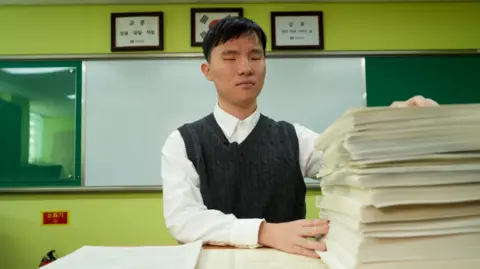
As each phrase, mark and diagram is transformed into braille, every exam document transforms into six to nine times thicker than the regular version.
Student Perspectives
In a specialized educational institution, 18-year-old Han Donghyun is one of the examinees who are preparing for the most extended form of the exam this year.
Last year, there were over a hundred blind test-takers nationwide – 99 with low vision and twelve with severe visual impairments like the student – according to information from the ministry.
Dong-hyun was born completely blind and is unable to perceive light.
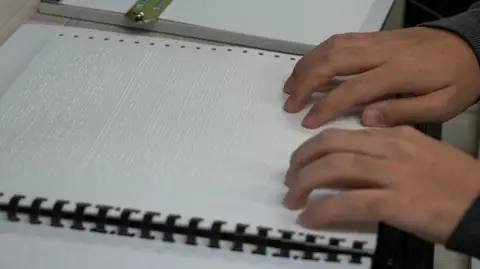
During an interview at his school, his fingers moved quickly across a tactile training material of previous test problems.
Approaching the examination date, he was focused on maintaining his stamina and condition. Dong-hyun will complete the test using tactile materials and a screen-reading computer.
"The fatigue is significant because the exam is so long," he mentioned. "But there's no special trick. I simply adhere to my preparation plan and attempt to maintain my well-being. This approach is essential."
The student said the Korean language section is particularly difficult for him.
Regular examination materials for that section is about sixteen pages – but the braille version is about one hundred pages long.
Even with screen-reading software, verbal content vanishes as immediately after it is heard, unlike written content that can be viewed and reviewed. Dong-hyun has to hold the details in his recall as he progresses.
The mathematics section is equally demanding.
He must interpret detailed charts and tables that have been transformed into braille, solely through his fingertips.
Nevertheless, he observed that things are better than they used to be. In the past, students had to do nearly every computations in their heads. However, recently, visually impaired students have been allowed to use a braille notetaker, called Hansone.
"Just like those with vision document their calculations in writing, we enter them in tactile format on the device to track progress," he said.

Endurance Challenges
A different examinee at Hanbit School, 18-year-old Oh Jeong-won, who will likewise complete the Suneung currently, said the late afternoon are "the most difficult period" of the session.
"Up until lunch, it's tolerable," he stated. "But around 4 or 5pm, following language sections and before Korean History, that period it gets really tough.
"There's no dinner break," he explained. "We continue answering questions while we would normally eat, so it feels even more exhausting. Still, I keep going because I know there will be a feeling of achievement at the conclusion."
For the student, the exhaustion is compounded by the need to stay intensely focused with both his hands and his hearing.
"While processing the tactile information with my fingers and simultaneously receiving content through audio, it seems significantly more exhausting than it does for sighted students," he said.
Accessibility Barriers
However, examinees say that the test duration and the long study hours are not the primary challenge. What is most challenging is availability of study materials.
Popular textbooks and digital classes that those with vision depend on are frequently inaccessible.
Limited numbers of tactile editions, and transforming resources into sound needs having text files – which are hard to acquire. Frequently, individuals must personally input complete materials to make them usable.
Online lectures present additional challenges, as numerous educators present information using written annotations, diagrams and graphics on screen, which are inaccessible through sound only.
A major obstacle, though, is the postponement in obtaining tactile editions of the state-produced study materials – a core set of resources directly connected to the standardized test.
Due to this postponement, visually impaired examinees often receive the materials months later than others.
"Those with vision get their EBS books between January and March and use them for the entire period," said Jeong-won. "We receive the tactile materials approximately in August or September, when the test is approaching quickly."
Dong-hyun expressed the same concern.
"The braille materials weren't completed until less than 90 days prior to testing," he mentioned. "I kept wishing the publication process could be faster."
The National Institute of Special Education, which produces the braille version of preparation resources, explained that the process takes at least 90 days for each book because it must follow relevant guidelines.
The institute added that it is "implementing multiple initiatives to ensure that blind students can learn uninterrupted, such as producing and supplying the resources in separate volumes."
The Korean Blind Union indicated it has consistently presented these concerns with {author


